Ransomware.YggGuru - Go ransomware targeting Documents
The sample
The file is a 64-bit Windows executable (PE32+) named update.exe.
- MD5:
b61d829b6b1fc2ecc12a86db5d99d826 - SHA-1:
2485276a4bed442d34f2b10ea0181c5152f95616 - SHA-256:
c3b71a279800e79535b096b110c9cf27ff16b92cf0a18200dd777a9abae9a5e7 - IMPHASH:
6ed4f5f04d62b18d96b26d6db7c18840
Detect It Easy identified the file as packed with UPX 5.11 using LZMA compression. The overall entropy of the packed binary was 7.99.
Triage and unpacking
I unpacked the file using upx -d, which produced update_unpacked.exe.
The overall entropy dropped to 6.27, but Detect It Easy still showed a local peak reaching 8.0 around offset 0x5759b0.
I got curious about the peak. It turned out to be Go's runtime symbol table (pclntab).
Strings and threat intelligence
Running strings produced a large text dump dominated by Go runtime internals, time zone names, and TLS error strings. Filtering through the noise revealed the ransomware artifacts:
- Ransom note header:
ALL YOUR FILES HAVE BEEN ENCRYPTED - Ransom note filename:
README_RESTORE.txt - Bitcoin address:
bc1q9x4m27d3kge0f8v5td0w4rjhkfz5a5nqpfsghr - Contact email:
noreply@ygg.guru - C2 endpoint:
https://ygg.guru/api/health - Encryption algorithm:
AES-256-GCM - Target extension:
.locked - Targeted processes:
excel.exe,msword.exe,mysqld.exe,postgres.exe,outlook.exe - Backup commands:
vssadmin,shadowcopy,wbadmin,catalog,bcdedit - Registry keys:
HKCU\Software\Microsoft\Windows\CurrentVersion\RunandHKCU\Software\Microsoft\Windows\CurrentVersion\Policies\System
The MD5 hash matched an AlienVault OTX pulse named Ransomware.YggGuru - Go-based ransomware with C2 exf.... VirusTotal showed 52 detections out of 71 engines. The binary also contained source path references to /Users/anthony/poc-cyber/cmd/ransomware/main.go.
README_RESTORE.txt
bc1q9x4m27d3kge0f8v5td0w4rjhkfz5a5nqpfsghr
noreply@ygg.guru
https://ygg.guru/api/health
Imports and dynamic loading
The import table lists only KERNEL32.dll.
Among the entries:
CreateThread,ResumeThread,SuspendThreadVirtualAlloc,VirtualFree,VirtualQueryCreateIoCompletionPort,GetQueuedCompletionStatusEx
There are no static imports for cryptography, networking, or the Windows registry. Go loads the other DLLs dynamically via LoadLibraryExW and GetProcAddress.
KERNEL32.dll
    LoadLibraryExW
    GetProcAddress
    VirtualAlloc
    CreateThread
    CreateIoCompletionPort
Execution flow in main.main
I opened the unpacked binary in IDA Pro and decompiled main_main using Hex-Rays.
The function executes the following sequence:
main_killProcessesterminates targeted processes to release file locks.main_deleteShadowCopiescallsvssadmin,wbadmin, andbcdeditto inhibit recovery.main_addPersistencewritesWindowsUpdateServiceunderHKCU\Software\Microsoft\Windows\CurrentVersion\Run.main_disableTaskManagersetsDisableTaskMgrin registry policies.main_enumerateDrivesandmain_getTargetDirset the target folder to%USERPROFILE%\Documents.poc_cyber_internal_pocrypto_GenerateKeygenerates a 32-byte key.- A loop calls
main_encryptFileon each target file using AES-256-GCM and counts successful encryptions. main_exfiltrateKeysends the machine ID, the key, and the file count tohttps://ygg.guru/api/health.main_dropRansomNotecreatesREADME_RESTORE.txtwith the count of affected files.main_setWallpapersetswall.bmp.runtime_memclrNoHeapPointerszeroes out the key in memory.
v0 = main_killProcesses();
v1 = main_deleteShadowCopies(v0);
main_addPersistence(v1);
r0 = main_disableTaskManager()._r0;
v32 = main_enumerateDrives(r0);
TargetDir = main_getTargetDir();
// ...
TargetFiles = main_getTargetFiles(TargetDir._r0, TargetDir._r1);
Key = poc_cyber_internal_pocrypto_GenerateKey(...);
// ...
while ( 1 ) {
  v33 = main_encryptFile(*v2, v2[1], v17, r1, r2);
  // increment encrypted file count
}
main_exfiltrateKey(r3, r4, TargetDir._r0, TargetDir._r1, ..., v25, ...);
v15 = main_dropRansomNote(TargetDir._r0, TargetDir._r1, v25);
main_setWallpaper(v15);
if ( Key._r1 != 0 )
  runtime_memclrNoHeapPointers(Key._r0);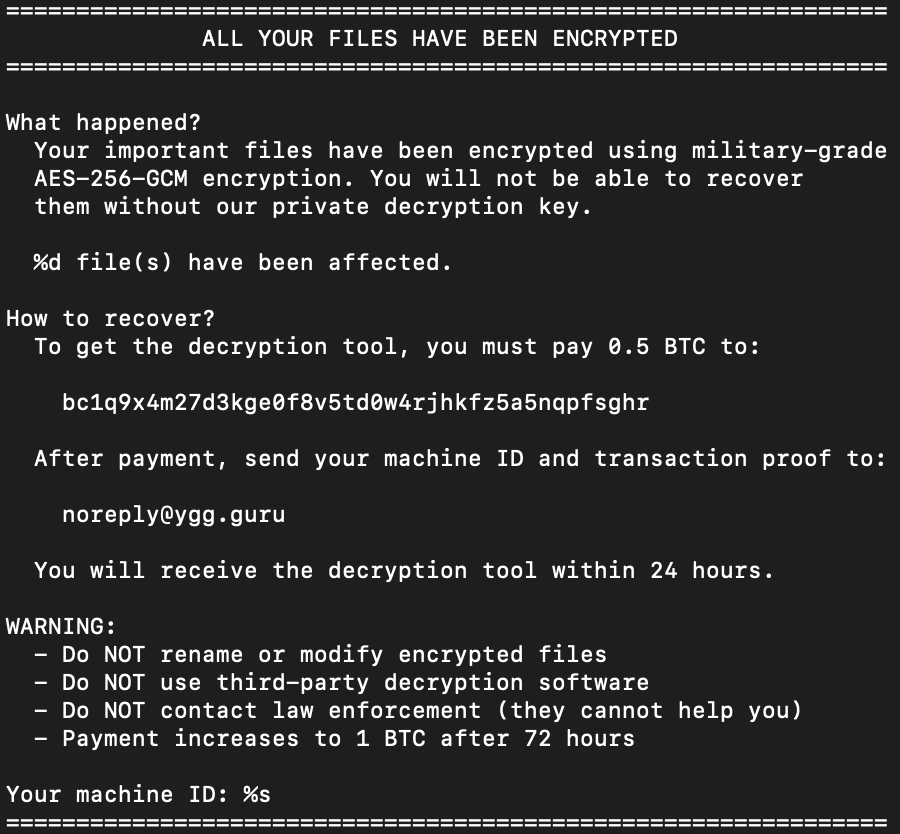
Indicators
- SHA-256:
c3b71a279800e79535b096b110c9cf27ff16b92cf0a18200dd777a9abae9a5e7 - MD5:
b61d829b6b1fc2ecc12a86db5d99d826 - C2 URL:
https://ygg.guru/api/health - Contact email:
noreply@ygg.guru - BTC address:
bc1q9x4m27d3kge0f8v5td0w4rjhkfz5a5nqpfsghr - Ransom note:
README_RESTORE.txt - Wallpaper:
wall.bmp - Extension:
.locked - Persistence key:
HKCU\Software\Microsoft\Windows\CurrentVersion\Run(WindowsUpdateService) - Policy key:
HKCU\Software\Microsoft\Windows\CurrentVersion\Policies\System(DisableTaskMgr = 1)
Takeaway
This was my first malware analysis and my first time using IDA and Detect It Easy. I read Practical Malware Analysis in parallel.
← all writeupsWritten with the help of AI, based on my own analysis and notes.