CrackMe 03 - First iOS experience
The target
iOSCrackme.ipa is an ordinary ZIP archive. Unpacking it gives Payload/iOSCrackme.app/iOSCrackme, a 99 KB ARM64 Mach-O.
The binary is not encrypted (cryptid = 0 in the load commands), so it can be opened in Ghidra directly.
The first real argument of an Objective-C method is in x2.
Finding the check
I didn't follow a fixed search strategy. I clicked through the function list and jumped around from _entry. Ghidra's Symbol Tree lists Objective-C classes, and that is where I found KeyValidator.
KeyValidator held six methods. From their names it was clear these were the stages of the check.
+[KeyValidator validate:]
+[KeyValidator stage1_length:]
+[KeyValidator stage2_structure:]
+[KeyValidator stage3_checksum:]
+[KeyValidator stage4_xorBlob:]
+[KeyValidator stage5_rollingHash:]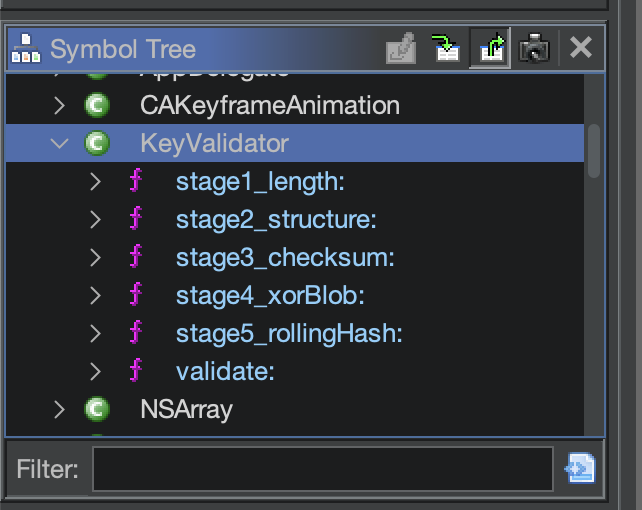
How the comparison works
validate: is a short-circuit chain. Each stage is called in turn and its result tested with cbz, and any failure jumps straight to the common exit and returns 0.
The stages don't depend on each other, so they can be solved one at a time.
bl  _objc_msgSend$stage1_length:
cbz w0, fail
bl  _objc_msgSend$stage2_structure:
cbz w0, fail
bl  _objc_msgSend$stage3_checksum:
cbz w0, fail
bl  _objc_msgSend$stage4_xorBlob:
cbz w0, fail
bl  _objc_msgSend$stage5_rollingHash:
Stage 4, and the assumption that cost the most
I started with stage4_xorBlob:, expecting it to work like the previous crackme. It turned out more complicated, with five stages.
The loop itself is not complicated. For each iteration it fetches a character from the input, XORs it with a key derived from the loop counter, and compares the result against a byte from a table. The XOR key is not constant. It is index + 0xAC, so every position uses a different one, which is what keeps the table from being readable as text.
The reference table sits at 0x100009221 and holds twelve bytes: EA 9E EF 82 E8 88 E8 81 99 FE 82 E6.
I wrote a short Python script inverting the transform, got a clean twelve-character string out of it, and typed that into the app. Rejected.
add  x2, x21, #4
bl   _objc_msgSend$characterAtIndex:
add  w8, w21, #0xac
eor  w9, w8, w0
add  x8, x20, x21
ldrb w10, [x8, #1]
cmp  w10, w9, uxtb
Stage 1 and 2, the layout
stage1_length: explains the rejection in three instructions: cmp x0, #0x11, so the key is 17 characters. My result was twelve. It was a fragment, not the answer.
stage2_structure: then fixes the shape of those 17 characters:
substringToIndex:3must equal the constant stringCM-characterAtIndex:7andcharacterAtIndex:12must both be0x2D, an ASCII hyphen- every remaining character must belong to
NSCharacterSet.alphanumericCharacterSet
The alphanumeric check skips positions 0, 1, 2, 7 and 12: the prefix and the two hyphens.
At first I didn't understand how my fragment fit: its first three characters were nothing like CM-.
bl   _objc_msgSend$substringToIndex:
bl   _objc_msgSend$isEqualToString:      ; "CM-"
...
mov  w2, #7
bl   _objc_msgSend$characterAtIndex:
cmp  w0, #0x2d
b.ne fail
mov  w2, #0xc
bl   _objc_msgSend$characterAtIndex:
cmp  w0, #0x2d
b.ne fail
Details that change the answer
Once I saw that the key is 17 characters long and starts with CM-, I understood that my fragment was not the beginning of the key. Then I noticed the first instruction of the stage4_xorBlob: loop body, add x2, x21, #4: the index is offset by four, so the twelve decoded characters occupy positions 4 through 15.
This fits stage 2: CM- in front and hyphens at 7 and 12.
That left two unknown positions: index 3 and index 16.
index:  0  1  2  3  4  5  6  7  8  9 10 11 12 13 14 15 16
        C  M  -  ?  F  3  A  -  X  9  Z  2  -  K  4  Q  ?
              ^--- stage2      ^--- stage4 covers 4..15
Stage 3, the last character
stage3_checksum: sums character codes and compares the total against 0x242.
add x20, x20, #2 advances the index by two, so only characters at even positions contribute to the sum.
Index 16 is even, and after the previous sections it was the only even position still unknown. The known even characters sum to 522, the target 0x242 is 578, so the missing character is 56, which is ASCII 8.
bl   _objc_msgSend$characterAtIndex:
add  x21, x21, w0, uxtb
add  x20, x20, #2
bl   _objc_msgSend$length
cmp  x20, x0
b.lo loop
cmp  x21, #0x242
cset w20, eq
Stage 5, the rolling hash
stage5_rollingHash: hashes the whole key using the constants 0x811C9DC5, 0x01000193 and 0x9E3779B9.
With index 16 resolved, only index 3 was left. I brute-forced it over digits and uppercase letters, and the digit 7 produced the expected value.
h = 0x811C9DC5
a = 0
for c in key:
    h = ((h ^ (c & 0xFF)) * 0x01000193) ^ a
    a = a + 0x9E3779B9
h == 0x7DB85890
Result
The key is CM-7F3A-X9Z2-K4Q8. Entering it in the app confirmed it, which was the only time the binary was executed.
The solver below contains no search at all, for reasons covered in the next section. It derives all 17 characters directly and uses the rolling hash purely as a check.
blob = [0xEA, 0x9E, 0xEF, 0x82, 0xE8, 0x88, 0xE8, 0x81, 0x99, 0xFE, 0x82, 0xE6]

key = ["?"] * 17
key[0], key[1], key[2] = "C", "M", "-"
key[7] = key[12] = "-"
key[3] = chr(0x37)

for i in range(12):
    key[i + 4] = chr(blob[i] ^ ((i + 0xAC) & 0xFF))

known_sum = sum(ord(key[i]) for i in range(0, 16, 2))
key[16] = chr(0x242 - known_sum)

candidate = "".join(key)


def rolling_hash(text):
    mask = 0xFFFFFFFF
    state = 0x811C9DC5
    salt = 0
    for char in text:
        state = (((state ^ (ord(char) & 0xFF)) * 0x01000193) & mask) ^ salt
        salt = (salt + 0x9E3779B9) & mask
    return state


print(candidate, rolling_hash(candidate) == 0x7DB85890)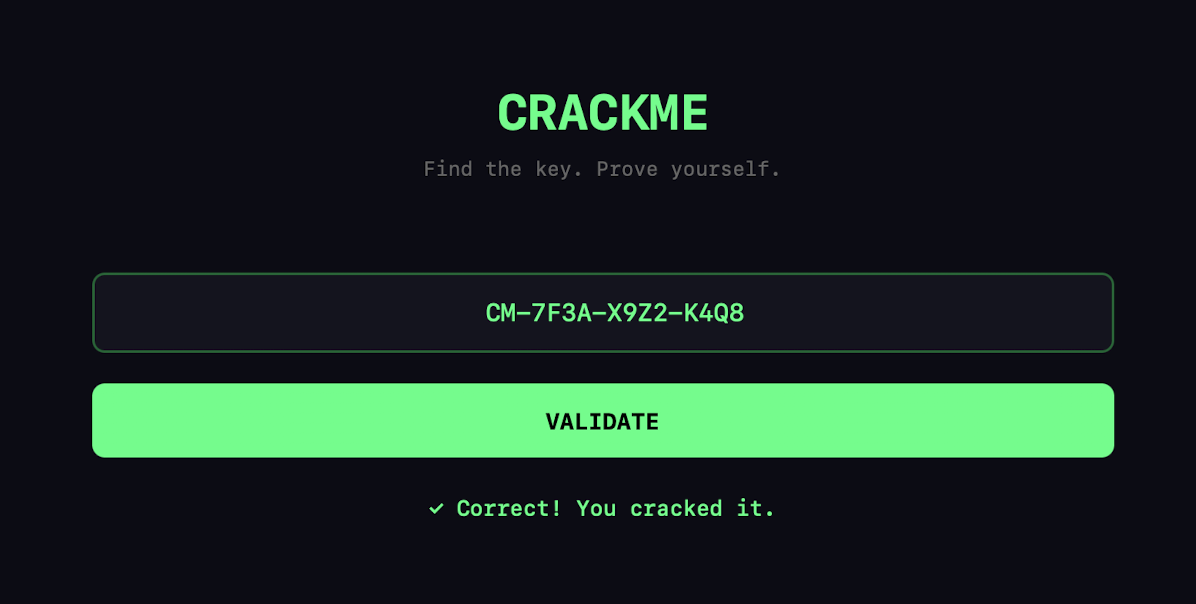
What I missed
The brute force in stage 5 was unnecessary. It turned out later that stage4_xorBlob: checks index 3 directly against a constant before its loop starts. 0x37 is 7.
bl   _objc_msgSend$characterAtIndex:   ; index 3
and  w8, w0, #0xff
cmp  w8, #0x37
b.ne fail
Anti-debugging that never fired
The binary also contains an AntiDebug class. I noticed it but did not analyze it. The binary was never run under a debugger, so it had no effect here.
Takeaway
This was my first iOS crackme and my first time seeing Objective-C.
← all writeupsWritten with the help of AI, based on my own analysis and notes.